Research Engineer | PhD Applicant in AI for Healthcare

Mohammad Imran Hossain

Multimodal AI for healthcare, medical image analysis, computational pathology, and spatial transcriptomics.

I am a Research Engineer at Institut Curie - PSL Research University in Paris, where I develop computational pipelines using deep learning and statistical methods to study the tumor microenvironment from histopathology and spatial transcriptomics data. My research focuses on developing multimodal AI, integrating radiology, digital pathology, multi-omics, and clinical information to advance personalized healthcare.

I hold two european master's degrees: an Erasmus+ Joint Master's in Medical Imaging and AI (MaIA), and a second Master's degree in Bioinformatics from Sorbonne University. My graduate training spans at top institutions in France, Italy, and Spain, and I have contributed to impactful research at Institut Curie, CNRS, and RadboudUMC. I completed a Bachelor of Science degree in Electrical Engineering from UIU in Bangladesh, graduating Summa Cum Laude and receiving the Vice-Chancellor's Award.

My academic and research training has been supported by competitive funding, including the EU-funded Erasmus Mundus scholarship, the Acquisis International Mobility Grant from the RBFC, and research internships at CNRS and Institut Curie. My work has been recognized with distinctions, including the Best Thesis Award. Beyond research, I am actively involved in academic and professional communities through the EMA and IEEE.

Actively seeking PhD positions in multimodal medical AI, medical image analysis, computational pathology, AI for precision medicine for the 2026/2027 intake.

Research

Research interests

My current research focuses on multimodal AI for healthcare, aiming to advance diagnosis, prognosis, and precision medicine. I develop deep learning methods that integrate radiomic features, tissue morphology, molecular information, and clinical records from real patient samples to support clinical decision-making. I am particularly interested in key challenges in multimodal learning, including fusion strategies, missing modalities, uncertainty estimation, and robustness in real-world clinical settings. More broadly, my work explores weakly supervised and self-supervised learning under limited-label conditions, alongside core medical image analysis tasks such as segmentation, registration, reconstruction, and AI-assisted diagnosis.
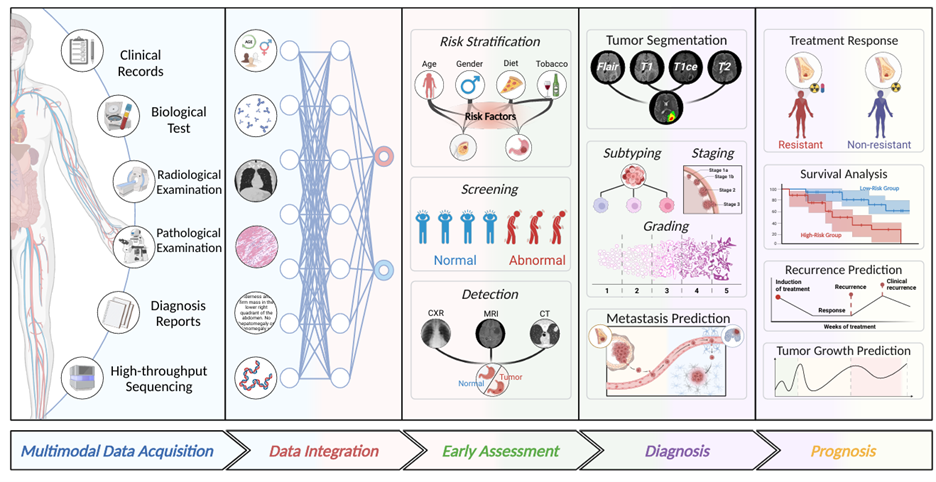
Diagram showing multimodal healthcare AI progressing from clinical, imaging, pathology, molecular, and records data through data fusion toward diagnosis, prognosis, and precision medicine outcomes.
Multimodal data integration for diagnosis, prognosis, and precision medicine. Source: Zhou et al., 2024.

Medical Image Analysis

Deep learning for medical image reconstruction, registration, segmentation, quantitative imaging, and AI-assisted methods for image-guided intervention and diagnosis.

Computational Pathology

AI-driven analysis of whole-slide histopathology images using weakly supervised learning, multiple instance learning, and foundation models to identify biomarkers, characterize the tumor microenvironment, and support precision oncology.

Spatial & Multi-omics

Development of computational pipelines for Visium HD and other spatial omics platforms, including cell-type deconvolution, spatial tissue profiling, and integration of histology with transcriptomic and multi-omics data for molecularly informed tissue mapping.

Experience

Research experience

Oct 2025 - Present

Research Engineer - Bioinformatics & AI

Institut Curie - PSL Research University, Paris, France

Leading development of multimodal computational pipelines integrating histopathology and spatial transcriptomics to study tumor microenvironment dynamics. Collaborating with clinical partners and preparing manuscripts.

Feb - Aug 2025

Research Intern - Bioinformatics & Spatial Transcriptomics

Institut Curie / Sanofi collaboration, Paris, France

Developed analysis pipelines for Visium V2 and Visium HD spatial transcriptomics data. Identified eight candidate genes potentially mediating CAF-driven T cell exclusion in lung squamous cell carcinoma. Manuscript in preparation.

Feb - Jul 2024

Research Intern - Computational Pathology

National Center for Scientific Research (CNRS), France

Benchmarked fully supervised, weakly supervised, and self-supervised approaches for HRD detection in breast and ovarian cancer whole-slide images. Best model achieved AUC 0.78 on breast cancer and 0.68 on ovarian cancer.

Aug - Oct 2023

Visiting Researcher - Medical Image Analysis

Diagnostic Image Analysis Group, Radboud University Medical Center, Netherlands

Developed preprocessing pipelines for k-space undersampling and evaluated deep learning models for real-time MRI reconstruction in interventional radiology.

Education

Academic background

2024-2025

Master of Computer Science, Bioinformatics and Modeling

Sorbonne University, France | Grade: 14.85/20 | Rank: 1st of 8 | Best Thesis Award

Thesis: Identification of Tumor Gene Signatures Underlying Fibroblast-Mediated T Cell Exclusion in Lung Cancer Using Spatial Transcriptomics.

2018-2022

B.Sc. in Electrical and Electronic Engineering

United International University, Bangladesh | GPA: 3.97/4.00 | Summa Cum Laude | Rank: 1st of 120

Preprints & Manuscripts

Research output

In preparation

Tumor Gene Signatures Underlying Fibroblast-Mediated T Cell Exclusion in Lung Cancer

Hossain M.I. et al. Institut Curie / Sanofi collaboration. Manuscript in preparation, 2026.

ArXiv 2024

Comparative Study of Probabilistic Atlas and Deep Learning for Brain Tissue Segmentation

Hossain M.I., Amin M.Z., et al. arXiv:2411.05456

ArXiv 2025

Deep Learning and Classical Computer Vision in Medical Image Analysis

Tweneboah A.D., Hossain M.I. (co-author), et al. arXiv:2502.19258

Projects

Selected research projects

Institut Curie / Sanofi | 2025

Spatial Transcriptomics Analysis of Tumor Immune Exclusion

Visium HD pipeline for identifying CAF-mediated T cell exclusion signatures in lung squamous cell carcinoma. Identified 8 candidate genes. Manuscript in preparation.

Diagram representing spatial transcriptomics analysis of tumor immune exclusion in lung squamous cell carcinoma
CNRS | 2024

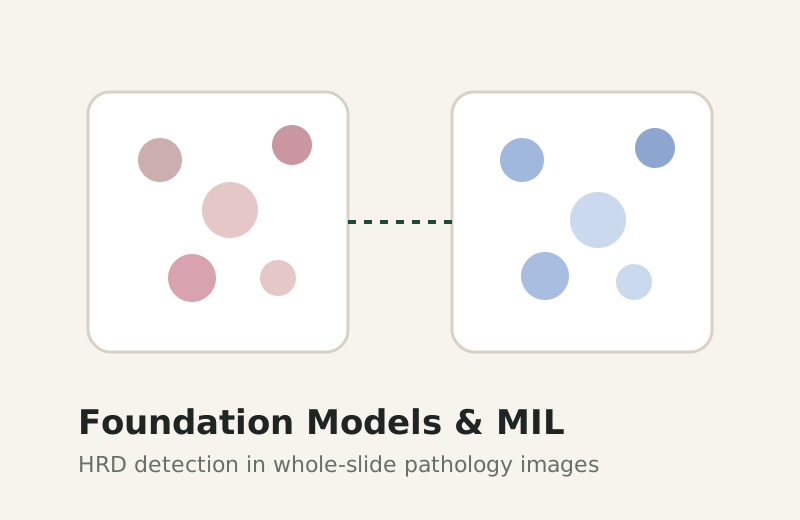
HRD Detection in Cancer WSIs via Foundation Models & MIL

Benchmarked AB-MIL, CLAM, Trans-MIL, and foundation models for homologous recombination deficiency detection. Achieved AUC 0.78 on breast cancer whole-slide images.

ArXiv preprint
Whole-slide imaging project figure for homologous recombination deficiency detection using foundation models and multiple instance learning
Sorbonne University | 2025

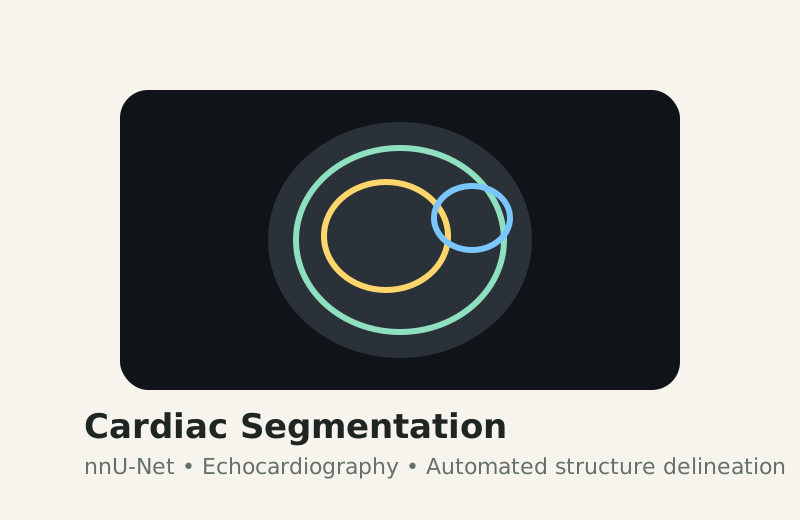
Cardiac Structure Segmentation from 2D Echocardiograms

nnU-Net pipeline for automated echocardiogram segmentation. Dice scores: LV endocardium 0.94, LV epicardium 0.91, left atrium 0.93.

Echocardiogram segmentation project figure showing automated cardiac structure delineation
Sorbonne University | 2024

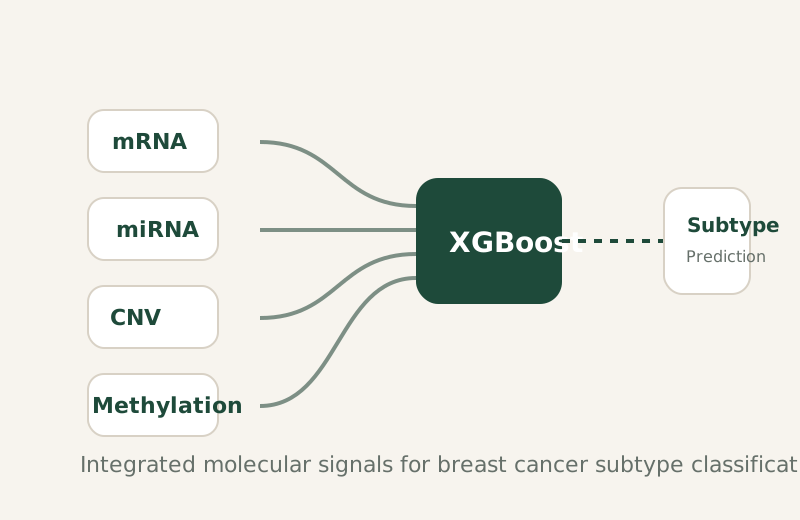
Breast Cancer Subtype Classification via Multi-omics Integration

XGBoost pipeline integrating DNA methylation, CNV, mRNA, and miRNA data for breast cancer subtyping. Balanced multiclass accuracy: 0.90.

Multi-omics integration diagram for breast cancer subtype classification with XGBoost